


Trying to conceive can be an emotional journey, especially when pregnancy does not happen despite regular attempts. Fortunately, modern fertility treatments offer several options for couples experiencing difficulty conceiving. Two commonly recommended treatments are IUI (Intrauterine Insemination) and IVF (In Vitro Fertilization).
But how do you know whether IUI or IVF is right for you?
The answer depends on several factors, including your age, fertility diagnosis, ovarian reserve, sperm health, fallopian tube condition, previous fertility treatments, and how long you have been trying to conceive. Understanding the difference between these treatments can help you have a more informed discussion with a fertility specialist.
If you are considering fertility treatment in Jayanagar, understanding the advantages, limitations, success factors, and differences between IUI and IVF is an important first step.
What Is IUI Treatment?
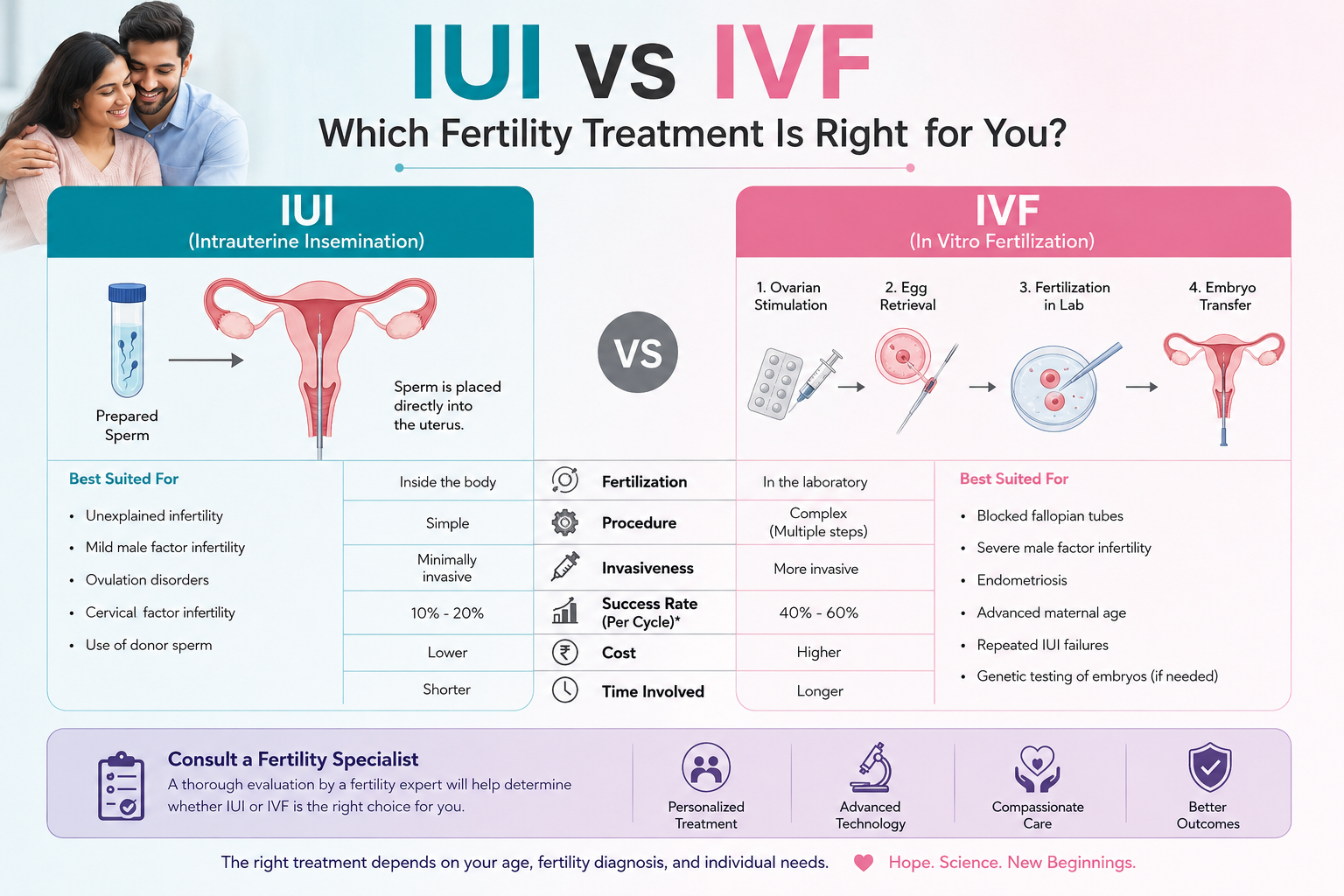
IUI, or Intrauterine Insemination, is a relatively simple fertility treatment in which specially prepared sperm are placed directly inside the uterus around the time of ovulation.
The goal is to increase the number of healthy sperm that reach the fallopian tubes, where fertilization may occur naturally.
During an IUI cycle, fertility medications may sometimes be prescribed to encourage the development of eggs. Ovulation is monitored through ultrasound and, when appropriate, medication may be used to trigger ovulation. Prepared sperm is then introduced into the uterus using a thin catheter.
IUI is less invasive than IVF and generally involves fewer medications and procedures.
When Is IUI Recommended?
IUI may be considered for people with certain fertility problems, such as:
- Unexplained infertility
- Mild male-factor infertility
- Problems with ovulation
- Difficulty with intercourse
- Certain cervical-factor problems
- Use of donor sperm
- Some cases where fertility medication alone has not resulted in pregnancy
However, IUI may not be suitable when there is severe male-factor infertility, significant tubal blockage, or certain other fertility conditions.
What Is IVF Treatment?
IVF, or In Vitro Fertilization, is a more advanced fertility treatment in which eggs are retrieved from the ovaries and fertilized with sperm in a laboratory.
After fertilization, an embryo develops under controlled laboratory conditions. An embryo may then be transferred into the uterus.
An IVF cycle usually involves ovarian stimulation, monitoring, egg retrieval, fertilization, embryo development, and embryo transfer. In some cases, additional laboratory procedures may be recommended depending on the couple’s individual circumstances.
Because fertilization takes place outside the body, IVF can overcome some fertility problems that cannot be effectively treated with IUI.
IUI vs IVF: What Is the Difference?
The biggest difference between IUI and IVF is where fertilization takes place.
With IUI, prepared sperm is placed inside the uterus and fertilization is expected to occur naturally inside the reproductive tract.
With IVF, eggs are retrieved from the ovaries and fertilized with sperm in a laboratory. The resulting embryo is subsequently transferred into the uterus.
| Feature | IUI | IVF |
|---|---|---|
| Fertilization | Occurs inside the body | Occurs in a laboratory |
| Egg retrieval | Not required | Required |
| Procedure complexity | Relatively simple | More involved |
| Laboratory fertilization | No | Yes |
| Embryo transfer | No | Yes |
| Cost | Generally lower | Generally higher |
| Treatment duration | Usually simpler | More steps involved |
| Suitable for severe fertility problems | Often not | May be appropriate in many cases |
The choice between IUI and IVF should not be based solely on cost or convenience. Your fertility specialist will consider your complete medical and reproductive history.
IUI vs IVF: Which Is More Successful?
One of the most common questions couples ask is whether IVF is more successful than IUI.
In general, IVF can offer higher pregnancy rates per treatment cycle for many patients, but success varies significantly according to age, egg quality, sperm quality, ovarian reserve, diagnosis, embryo quality, and other factors.
IUI may have lower success rates per cycle but can be a reasonable first-line treatment for selected patients because it is simpler and less invasive.
For some couples, trying IUI before moving to IVF may be appropriate. For others, going directly to IVF may save valuable time, particularly when age or a specific fertility diagnosis is an important factor.
Therefore, there is no single treatment that is best for everyone.
When Is IUI a Better Option?
IUI may be considered when the fertility problem is relatively mild and the fallopian tubes are functioning adequately.
For example, a fertility specialist may recommend IUI when:
- Ovulation problems can be managed with medication
- Sperm quality is mildly reduced
- The cause of infertility remains unexplained
- At least one fallopian tube is open and functioning
- The individual is suitable for a less invasive treatment
- Donor sperm is being used
IUI can also be attractive to couples who want to begin with a simpler treatment approach before considering more advanced procedures.
However, repeated unsuccessful IUI cycles may lead a fertility specialist to recommend moving to IVF, depending on the individual circumstances.
When Is IVF Recommended?
IVF may be recommended when there are fertility factors that make natural fertilization difficult or when other treatments have not been successful.
IVF may be considered in situations such as:
- Blocked or severely damaged fallopian tubes
- Severe male-factor infertility
- Certain ovulation or ovarian conditions
- Reduced ovarian reserve
- Advanced reproductive age
- Repeated unsuccessful IUI cycles
- Certain cases of unexplained infertility
- Need for certain embryo-related testing
- Previous fertility treatment failures
IVF can provide greater control over several stages of conception because eggs, sperm, fertilization, and embryo development can be monitored in a laboratory.
IUI vs IVF for Male Infertility
Male-factor infertility is relatively common and can range from mild abnormalities in sperm count or movement to severe sperm-related problems.
IUI may be useful in selected cases of mild male-factor infertility when enough healthy sperm can be obtained after sperm preparation.
However, when sperm count or motility is significantly reduced, IVF with an additional fertilization technique such as ICSI may be considered.
The appropriate approach depends on the semen analysis and the overall fertility assessment of both partners.
IUI vs IVF for Blocked Fallopian Tubes
Fallopian tubes play an important role in natural conception because they provide the location where sperm and egg normally meet.
If both fallopian tubes are blocked, IUI generally cannot overcome the blockage because sperm still needs to reach the egg through the reproductive tract.
In such situations, IVF treatment may be recommended because the egg can be retrieved directly from the ovary and fertilized outside the body.
This is one example where IVF may be more appropriate than repeatedly attempting IUI.
How Does Age Affect the Choice Between IUI and IVF?
Age is an important factor when deciding on fertility treatment because female fertility generally declines with age, particularly because egg number and egg quality decrease over time.
Younger patients with relatively favorable fertility factors may have more time to try simpler approaches such as IUI when clinically appropriate.
For older patients, a fertility specialist may recommend a more effective treatment strategy sooner rather than spending several months on treatments with lower chances of success.
The decision should always be individualized rather than based on age alone.
How Many IUI Cycles Should You Try Before IVF?
There is no universal number of IUI cycles that applies to everyone.
Some couples may become pregnant after their first IUI cycle, while others may require multiple attempts. If several appropriately selected IUI cycles are unsuccessful, your fertility specialist may reassess the diagnosis and discuss whether IVF would provide a better opportunity.
Factors such as age, ovarian reserve, sperm quality, duration of infertility, and previous treatment outcomes can influence this decision.
It is important not to continue repeating the same treatment indefinitely without reassessing the underlying fertility factors.
IUI vs IVF Cost
Cost is another important consideration when choosing between IUI and IVF.
Generally, IUI is less expensive per cycle because it involves fewer medications, procedures, and laboratory processes.
IVF is usually more expensive because it involves ovarian stimulation, egg retrieval, laboratory fertilization, embryo culture, and embryo transfer. Additional procedures or medications may also affect the overall cost.
However, comparing only the cost of one cycle may not provide the complete picture. A less expensive treatment with a lower chance of success may require multiple cycles, while a more advanced treatment may sometimes provide a higher chance of pregnancy in a suitable patient.
Discuss the expected treatment plan and costs with your fertility clinic before beginning treatment.
Choosing the Right Fertility Treatment
The most important point to remember is that IUI vs IVF is not a competition between two treatments. They are different fertility treatment approaches designed for different circumstances.
Your fertility specialist may consider:
- Your age
- Duration of infertility
- Ovulation status
- Ovarian reserve
- Fallopian tube condition
- Sperm count and motility
- Previous pregnancy history
- Previous fertility treatments
- Overall reproductive health
- Your treatment preferences
Based on these factors, your doctor can recommend whether IUI, IVF, or another fertility approach is appropriate.
Finding Fertility Care in Jayanagar
If you are searching for IVF treatment in Jayanagar, it is important to choose a fertility centre where your individual fertility concerns can be properly evaluated rather than selecting treatment based only on online success claims.
A Best Fertility Clinic in Jayanagar should provide appropriate fertility evaluation, explain available treatment options, discuss expected benefits and limitations, and help you understand why a particular treatment has been recommended.
When searching for a Best IVF Centre in Jayanagar, Best IVF Specialist in Jayanagar, or Best IVF Doctor in Jayanagar, consider factors such as the doctor’s experience, fertility services available, laboratory facilities, treatment approach, communication, and whether the clinic provides individualized care.
Similarly, if you are looking for a Best Fertility Doctor in Jayanagar, choose a specialist who takes time to understand both partners’ fertility history and explains the available options clearly.
When Should You Consult a Fertility Specialist?
Consider consulting a fertility specialist if you have been trying to conceive without success, especially if there are known fertility concerns or you have risk factors that may affect fertility.
You may benefit from an earlier evaluation if there is a history of irregular ovulation, previous pelvic surgery, known fallopian tube problems, endometriosis, recurrent pregnancy loss, or male-factor fertility concerns.
An early evaluation does not necessarily mean that you will need IVF. It simply helps identify potential problems and allows you to understand your treatment options.
Frequently Asked Questions
Is IUI better than IVF?
Neither treatment is universally better. IUI may be appropriate for selected patients with relatively mild fertility problems, while IVF may be recommended when more complex fertility factors are present or when IUI has not worked.
Is IVF more successful than IUI?
IVF can provide higher success rates per treatment cycle for many patients, but individual success depends on age, egg and sperm quality, diagnosis, embryo quality, and other factors.
Can I try IUI before IVF?
Yes. For appropriately selected patients, IUI may be tried before IVF. However, some patients may be advised to proceed directly to IVF based on their age, fertility diagnosis, or previous treatment history.
How do I know whether I need IUI or IVF?
A fertility specialist can recommend the most suitable option after evaluating ovulation, ovarian reserve, fallopian tubes, sperm health, age, and previous fertility history.
Is IUI less expensive than IVF?
Generally, yes. IUI usually involves fewer medications and procedures, making the cost per cycle lower than IVF. However, the overall cost depends on the number of cycles and individual treatment requirements.
Conclusion
Choosing between IUI vs IVF is an important decision, but there is no single fertility treatment that is right for every couple. IUI may be suitable for selected patients with mild fertility concerns, while IVF can be a better option when there are blocked fallopian tubes, significant male-factor infertility, reduced fertility potential, repeated treatment failures, or other complex fertility factors.
The best approach is to undergo a proper fertility evaluation and discuss your options with an experienced fertility specialist. Understanding your diagnosis, treatment goals, expected success rates, timeline, and costs can help you make a confident and informed decision.
If you are considering IUI or IVF treatment in Jayanagar, consult a qualified fertility specialist to understand which treatment approach is appropriate for your individual fertility needs.
